
What Makes a Local Business Show Up First in Search Results?
When someone searches for a service you provide in your area, why does one business appear prominently while another barely shows up?
There usually isn’t one answer.
Local visibility is built from a collection of signals that help search engines understand who you are, what you do, where you work, whether your business is credible, and whether your website actually answers what the searcher is looking for.
For business owners, that means local search engine optimization isn’t about finding one secret trick or stuffing a city name onto every page. It’s about building a trustworthy, useful, well-connected business’s online presence across Google Maps, your website, local listings, customer reviews, local directories, social media, and the wider web.
Google explains that local results are primarily shaped by relevance, distance, and prominence. Those broad concepts are influenced by many practical details: accurate information, the strength of your business listing, the quality and usefulness of your web pages, links and mentions around the web, reviews, and how closely your business matches a searcher’s intent.
The exact weighting isn’t public, and different results can appear based on the query, the searcher’s location, and other context.
So if your goal is to reach the first page of Google, appear more often in the local pack, or earn one of the top spots for valuable location-based searches, the best practice is to improve the whole local search ecosystem rather than chase a single ranking factor.
Here are the key factors I look at when evaluating why a local service business is—or isn’t—being found.
Google Business Profile Optimization
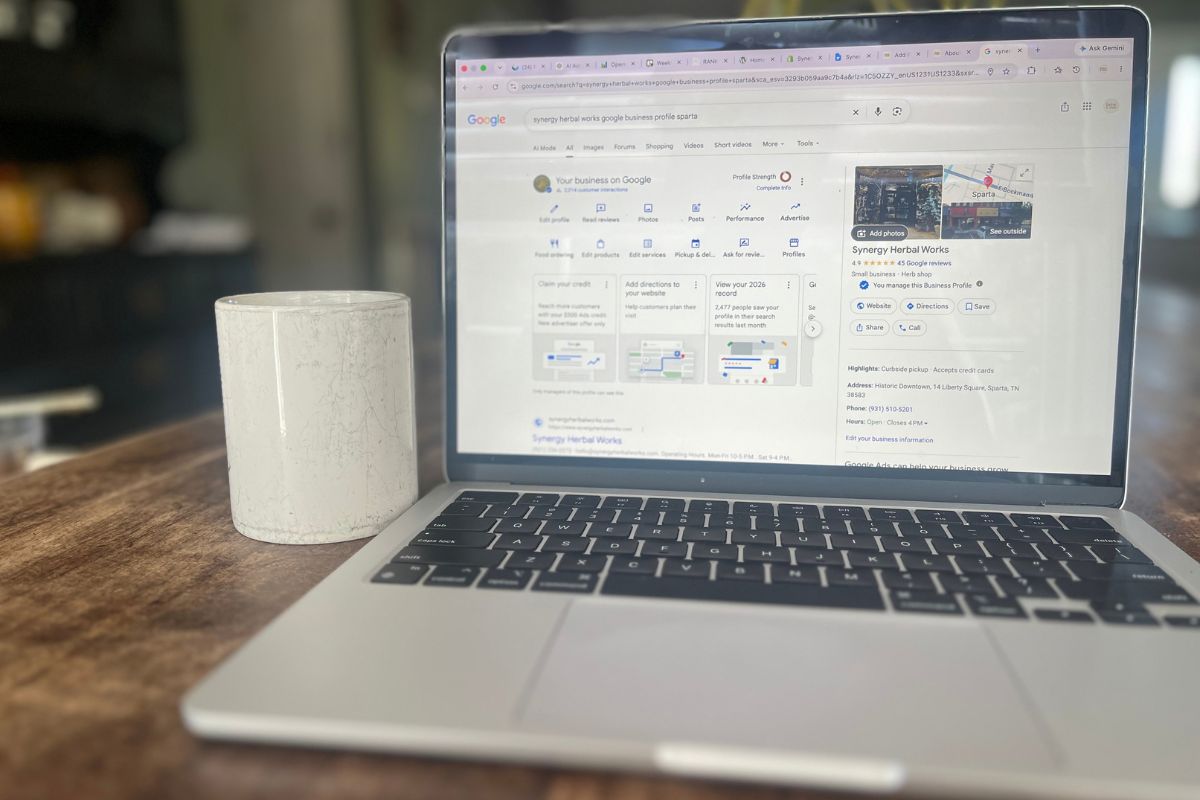
Your Google Business Profile—formerly commonly called a Google My Business page or GMB listing—is one of the most important pieces of local visibility.
It’s the business listing that can appear in Google Search and Google Maps, including the local pack that often sits near the top of search results for local-intent queries.
Google Business Profile optimizations help Google and potential local customers understand what your company does, where it operates, when it’s open, and how to contact it.
A complete, accurate profile doesn’t guarantee a higher ranking, but Google specifically recommends keeping business information complete and up to date because it helps a profile match relevant local results.
Complete the Important Fields in Your Profile
Start with the fundamentals. Your profile should accurately reflect the real-world business:
- Business name: Use the real business name as it’s represented in the real world. Don’t add extra local keywords simply to influence rankings.
- Primary and secondary categories: Choose the type of business and categories that most accurately describe what you actually do. Your primary category should reflect the core business.
- Business address or service area: Use the correct setup for the business. A storefront may display its business address; an eligible service-area business may define the areas it serves.
- Business hours: Keep regular and special hours current so customers aren’t relying on outdated information.
- Contact information: Make sure the phone number and website URL are correct and lead to the right place.
- Business description: Write a clear description of the company, its primary services, and the local market it serves without turning it into a block of keyword stuffing.
- Services and attributes: Add applicable services and attributes that give customers—and Google—more useful context about the business.
- Photos and videos: Use real, current imagery that helps a potential customer understand your team, work, property, products, or services.
The first step isn’t to make the profile sound optimized. It’s to make it accurate, complete, and useful.
Search engines can pull local business information from several sources, including the company’s own website, third-party data, user contributions, and the verified Business Profile. Consistency makes that ecosystem easier to understand.
Use Google Business Profile Posts as a Customer Communication Tool
Google Business Profile posts can be a useful way to share timely updates, services, projects, events, and offers.
I wouldn’t treat weekly posting as a guaranteed ranking boost. Google doesn’t publish a rule saying that a certain posting frequency automatically moves a business higher.
The stronger reason to use posts is that they keep the profile useful to people who are already discovering the business.
Great ways to use posts include:
- Highlighting a seasonal local service or timely customer need.
- Sharing a completed project, new service, event, or company update.
- Answering questions customers frequently ask before contacting you.
- Sending visitors to a relevant service page, quote page, booking page, or other useful destination.
For a fencing company, a post showing a recently completed commercial chain-link project is more useful than a generic motivational graphic.
For a medical practice, an update about a new service, provider, or scheduling change may be more valuable.
Match the content to the type of business and what its customers actually need.
Respond to Customer Reviews
Online reviews matter for both visibility and conversion.
Google says review count and positive ratings can contribute to local prominence, and thoughtful responses show customers that their feedback matters.
That makes review management an important part of local SEO strategies, even though Google doesn’t publish a formula that rewards a specific response time.
A practical review-response process looks like this:
- Positive feedback: Thank the customer and respond specifically to what they shared.
- Critical feedback: Stay professional, avoid defensiveness, and move sensitive resolution details offline when appropriate.
- Short or neutral feedback: Acknowledge it genuinely rather than forcing keywords into the reply.
- Never fabricate services, locations, or customer details simply to make a response more keyword rich.
High-quality reviews are most valuable when they reflect a genuine customer experience.
If customers naturally mention the service they received or the specific locations where work occurred, that context can be helpful to future customers. But businesses shouldn’t pressure reviewers to include specific phrases.
NAP Consistency and Accurate Business Information
NAP stands for Name, Address, and Phone Number.
You’ll still hear this term throughout local search engine optimization because accurate contact information across the web matters for customers and for the systems trying to understand a business.
The goal isn’t obsessive character-for-character perfection in every harmless formatting detail.
The goal is to avoid genuinely conflicting information: an old phone number, the wrong business address, a former brand name, duplicate local listings, or a directory profile that sends customers somewhere the business no longer operates.
Where Local Citation Problems Hide
Local citations are mentions or listings of a business across the web.
Depending on the company, useful places to audit may include:
- Major local directories and map platforms.
- Industry-specific directories, such as legal or healthcare directories when relevant.
- Local chamber of commerce and association profiles.
- Supplier, partner, franchise, or professional organization pages.
- Old local listings created before a rebrand, move, acquisition, or phone-number change.
- Local news, sponsorship, and community pages that contain outdated contact information.
Citation-management platforms can make this easier, but a manual spot-check is still useful.
For multi-location brands, each location should have a clearly defined identity and accurate location-specific information rather than one confusing set of details reused everywhere.
Reviews, Reputation, and Customer Trust
Reviews aren’t just stars beside a business name.
They’re part of the decision-making experience for local customers.
Review quantity, recency, sentiment, and the substance of what people say can all influence how confident a potential customer feels.
Google states that more reviews and positive ratings can help local ranking, but there’s no public formula saying a business needs a certain number of reviews per week or that a particular star-rating range is ideal.
The better strategy is to build a repeatable process for earning genuine reviews over time.
Build Review Requests Into the Customer Journey
Some of the best ways to do that are simple:
- Send a polite text or email after a completed job or service with a direct Google review link.
- Train the team to mention reviews naturally at the end of a successful customer experience.
- Use a QR code on a thank-you card, receipt, leave-behind, or other appropriate material.
- Make the request easy, optional, and available to customers regardless of whether you expect positive feedback.
Don’t offer a discount, free product, raffle entry, or other incentive in exchange for a Google review.
The goal is authentic feedback, not rating manipulation.
A good example is a contractor who leaves a small review card after the final walkthrough. The card can invite the customer to scan a QR code and share what the project was and what the experience was like.
That creates useful customer reviews without scripting the customer’s opinion.
Star Rating Matters—But Context Matters Too
Potential customers usually evaluate more than the average star rating.
They may notice the number of reviews, how recent they are, whether the comments sound detailed and believable, how the business handles criticism, and whether the reviews describe work similar to what they need.
That’s why I’d rather see a company consistently earn honest, high-quality reviews than chase a mathematically “perfect” profile.
A trustworthy brand is built by the customer experience first. The review profile is evidence of that experience.
On-Page SEO for Local Intent
Your website needs to help search engines and humans understand what you do and where you do it.
If you’re a plumber serving Cookeville, Tennessee, but your most important web pages never explain that service area, you’re making the relevance connection harder than it needs to be.
Use Local Keywords Where They Actually Help the Reader
Keyword research should guide page strategy, not turn the copy into a list of repeated phrases.
Once you understand the local keywords people use, place them naturally in the elements that describe the page.
That includes:
- Title tag: Clearly describe the primary service and relevant market.
- Meta description: Summarize the page in a way that earns the click. It can include the service and city name when natural.
- H1 and supporting headings: Make the main topic unmistakable.
- Body copy: Explain the service, process, customer needs, service area, and differentiators in useful language.
- Image alt text: Describe the image accurately. Don’t turn alt text into a location-keyword dumping ground.
- Internal links: Connect related services, locations, projects, FAQs, and resources so users and search engines can navigate the site.
Local business websites should be specific enough to establish relevance without reading like they were written for an algorithm.
The best match for a searcher isn’t necessarily the page with the most city names. It’s the page that genuinely satisfies the search intent.
Create Service and Location Pages Strategically
If you serve multiple markets, dedicated location pages can be useful when there’s a real reason for each page to exist.
I wouldn’t automatically create a separate page for every ZIP code, neighborhood, or town simply because the business can drive there.
A strong location page may include:
- The specific location or market in the title, URL, and main heading where appropriate.
- Services actually available in that area.
- Original projects, customer stories, photos, testimonials, or proof tied to that market when available.
- Useful local context that affects the service or buying decision.
- Clear contact information and a relevant call to action.
- Internal links to the primary service pages and related resources.
For multi-location brands, this becomes even more important because each physical location may need its own local landing experience and structured data.
For service-area businesses, the architecture should reflect real service priorities rather than producing dozens of nearly identical web pages.
Local Content That Supports Search and Sales
Content marketing can support local visibility, but “publish more blogs” isn’t a complete strategy.
Before creating informational content, make sure the site has strong money pages for the services the business actually wants to sell.
Then use content to answer questions, support those service pages, demonstrate expertise, and capture searches that happen earlier in the buying journey.
Write About Real Local Questions and Problems
Useful content ideas might include:
- Seasonal service guides: “Preparing Your HVAC System for Tennessee Winters.”
- Cost and planning guides: “What Affects the Cost of Commercial Fencing in Middle Tennessee?”
- Problem-solving resources: “What to Do If Your Basement Floods During a Tennessee Storm.”
- Relocation or market guides when they connect naturally to the service.
- Project stories: “How We Built a Commercial Security Fence for a Sparta Facility.”
- FAQs based on questions the sales team hears repeatedly.
This is where keyword research becomes especially valuable.
Search data can show whether people want a service page, a cost guide, a comparison, a how-to answer, or a location-specific resource. The content format should follow the intent.
There’s no universal rule that every local business needs to publish weekly or even monthly.
One genuinely useful resource that supports a high-value service can be more valuable than four thin posts created only to meet a content calendar.
Build Local Authority Through Relevant Mentions and Links
Links and mentions from relevant websites can contribute to prominence and help search engines understand a company’s place in its local market.
Local authority can come from chambers of commerce, professional associations, suppliers, community organizations, sponsorships, local media, project partners, and other legitimate relationships.
Great ways to earn those mentions include:
- Participating in community events or sponsorships where the business is genuinely involved.
- Joining relevant local or industry organizations.
- Providing expert commentary to journalists when the company has something useful to add.
- Publishing noteworthy project or community stories that other organizations have a reason to reference.
- Making sure legitimate partner and vendor profiles contain accurate information and a useful link where appropriate.
I wouldn’t reduce this to a claim that one local backlink is always worth ten national links.
Relevance, quality, context, authority, and the overall link profile all matter.
The principle is to earn real mentions from places that make sense for the business.
Mobile Experience, Site Speed, and Conversion
Local search often happens on a phone, which makes mobile usability especially important.
Google’s search systems consider overall page experience, including mobile usability and Core Web Vitals, but there isn’t one magic load-time number that guarantees—or destroys—rankings.
Think about this from the customer’s perspective.
If someone needs an emergency repair, a fence estimate, or an appointment with a medical practice, the site should make the next step obvious.
Improve Performance Without Chasing a Perfect Score
Common issues worth checking include:
- Oversized or poorly optimized images.
- Heavy scripts, tracking tools, chat widgets, or third-party embeds.
- Slow server response or weak hosting.
- Poor caching or unnecessary plugins.
- Layout shifts, hard-to-tap buttons, or mobile navigation problems.
- Important content or calls to action that are difficult to find on a phone.
Google PageSpeed Insights is a free tool that can help surface performance and Core Web Vitals issues.
Use it as diagnostic information—not as a mandate to chase a perfect score while ignoring the actual customer experience.
Make It Easy to Contact the Business
For many local service businesses, conversion basics matter just as much as traffic.
Make sure you:
- Keep the phone number visible and clickable on mobile.
- Use clear quote, booking, or contact calls to action.
- Keep forms as simple as the sales process allows.
- Show proof near conversion points, such as reviews, project photos, credentials, or relevant trust signals.
- Explain what happens after someone submits the form or calls.
A higher ranking is only valuable if the website turns the right visitors into inquiries, appointments, purchases, or foot traffic.
Search Engine Signals Beyond Google
Google is the largest search ecosystem for many local businesses, but it isn’t the only place customers discover companies.
Bing, Apple Maps, industry directories, social media platforms, review sites, and emerging AI-assisted search experiences can all contribute to discovery.
Claim and Maintain Bing Places and Other Relevant Local Listings
If Bing is relevant to your audience, claim and maintain the business listing there.
Do the same for other reputable local listings and directories that customers in your industry actually use.
The objective isn’t to be listed on every directory on the internet. It’s to build an accurate, trustworthy footprint in the places that matter.
For a local service company, that may include maps platforms, chamber listings, BBB or trade associations, and industry-specific directories.
For a medical practice, the relevant ecosystem may also include healthcare directories.
Choose platforms based on the business and its customers.
Use Social Media as a Supporting Trust Channel
An active Facebook, Instagram, LinkedIn, or other social media presence can support the broader customer journey by showing recent work, people, expertise, and proof of activity.
I wouldn’t tell a business to post weekly because a search algorithm requires it, and I wouldn’t delete an established profile simply because posting has slowed.
Instead, keep core business information accurate, use the channels your customers actually pay attention to, and let social media reinforce the same positioning people see on the website and local profiles.
Technical SEO and Search Engine Clarity
A strong local strategy also depends on whether search engines can crawl, index, and understand the site.
Beautiful copy can’t do much if important pages are accidentally blocked, canonicalized incorrectly, buried in the architecture, or missing from the index.
Technical checks may include:
- Indexability of important service and location pages.
- XML sitemap health and Search Console indexing information.
- Broken links, redirects, duplicate pages, and canonical tags.
- Clear internal linking and avoidance of orphan pages.
- Appropriate LocalBusiness or Organization structured data.
- Mobile usability and Core Web Vitals.
- Security, crawl accessibility, and major rendering issues.
Google Search Console should be part of the ongoing measurement process.
It’s another free tool that shows how a website is performing in organic search results, including queries, impressions, clicks, pages, indexing information, and other search data.
Local Search Algorithms: What Google Actually Tells Us
Local search algorithms are complex, and Google intentionally doesn’t publish a checklist of exact weights.
What Google does tell us is that local ranking is primarily based on relevance, distance, and prominence.
Relevance
How closely the business or page matches what the searcher is looking for.
Distance
How far a potential result is from the location used or inferred for the search.
Prominence
How well known the business is. This can be informed by real-world prominence and signals such as links, reviews, and other information Google can find about the business.
This helps explain why two people can perform similar location-based searches and see different results.
A business farther away can sometimes be considered a better match. It also explains why there’s no legitimate service that can simply pay Google for the top of Google’s organic local results.
Search Is Expanding: AI Overviews, Answer Engines, and Entity Clarity
In today’s digital age, what we mean by “search visibility” is changing.
Traditional search engine results still matter enormously, but customers may also encounter AI Overviews, conversational search experiences, map results, featured answers, and other discovery surfaces.
That doesn’t mean local businesses need an entirely separate website for GEO or AEO.
Many of the same fundamentals that support search engine optimization also make a business easier for modern search systems to understand:
- Clear service pages.
- Accurate business information.
- Strong About content.
- Useful FAQs.
- Real project examples and case studies.
- Structured data.
- Customer reviews.
- Credible third-party mentions and local citations.
For business owners, the practical question is:
Can a search system clearly determine who you are, what you offer, where you operate, why you’re credible, and which page contains the best answer to a specific question?
A well-structured FAQ can help answer questions in natural language.
A detailed service page can explain expertise and process.
A project case study can connect a service to a real outcome and specific location.
An accurate Google Business Profile and consistent local citations reinforce the business entity.
Together, those assets create a clearer digital footprint for traditional search engines and newer AI-assisted experiences.
Measure What Is Actually Happening
Local SEO shouldn’t be managed by gut feeling alone.
Google Search Console, Google Analytics, Google Business Profile performance data, lead tracking, and sales feedback can help show whether visibility is translating into meaningful business activity.
Useful questions include:
- Which local keywords and service queries are beginning to earn impressions or clicks?
- Which web pages attract organic search traffic, and which pages convert?
- Is the business appearing for the services it actually wants to grow?
- Are calls, forms, bookings, directions, or foot traffic increasing?
- Which markets or specific locations are producing qualified leads?
- Are high-impression pages sitting just outside the strongest organic search results?
- Do customer reviews and sales conversations reveal questions the website should answer?
This is where strategy becomes more valuable than a generic checklist.
One business may need a better commercial service page.
Another may need to fix tracking.
Another may have strong rankings but a weak conversion path.
Another may need more authority in its local market.
The next best move depends on the baseline.
The Best Local SEO Strategies Work as a System
If you want your business to appear more often on the first page of Google, in Google Maps, in the local pack, and across other search experiences, don’t think of local SEO as 15 isolated tricks.
Think of it as a system.
Your Google Business Profile establishes important local business information.
Your website explains your services and markets in depth.
Your local citations and listings reinforce accurate information.
Customer reviews provide social proof.
Useful content answers questions.
Relevant links and mentions strengthen authority.
Technical SEO makes the site accessible.
Measurement shows what’s working and what needs attention.
Those are some of the best ways to build a business’s online presence that’s useful to people first and understandable to search engines second.
And that’s the real goal.
Not to “beat the algorithm” for a week, but to build a digital presence that makes your company a credible, relevant, useful best match when local customers are looking for exactly what you do.
A Practical Local SEO Checklist
Before you start chasing the top of Google, make sure the foundation is actually there.
- Verify and accurately complete the Google Business Profile/GMB listing.
- Confirm the business name, business address or service area, phone number, website, hours, categories, services, and business description.
- Audit major local listings and local directories for outdated or conflicting information.
- Create a repeatable process for requesting genuine online reviews from customers.
- Respond thoughtfully to customer reviews without forcing keywords.
- Use keyword research to map high-value local keywords to the right service, location, project, or resource pages.
- Strengthen core service pages before publishing content simply for volume.
- Create location pages only where there is enough unique value and business relevance to justify them.
- Improve mobile usability, conversion paths, and site performance.
- Use LocalBusiness structured data where appropriate and validate it.
- Monitor organic search results and indexing in Google Search Console.
- Build relevant local authority through legitimate organizations, media, partners, suppliers, and community involvement.
- Use social media to reinforce trust and recent activity where it makes sense for the audience.
- Structure content so it clearly answers questions for traditional search, AI Overviews, and other AI-assisted discovery experiences.
- Review performance regularly and choose the next growth initiative based on business goals and real data.
Final Takeaway
Showing up locally is rarely about one missing keyword or one setting inside a Google My Business page.
It’s the result of many connected signals that help customers and search systems understand the business.
Start with accurate information.
Build strong service pages.
Earn genuine reviews.
Make it easy for people to contact you.
Create content when it answers a real search need.
Strengthen your local reputation and authority.
Then use the data to decide what deserves attention next.
That’s how local businesses build sustainable visibility—not by chasing every algorithm rumor, but by becoming clearer, more useful, more credible, and easier to find.
Ready to Strengthen Your Digital Visibility?
If you know your business should be showing up more often—but you aren’t sure whether the problem is your website, SEO, Google Business Profile, content, local visibility, conversion strategy, or something else—that’s exactly where strategy matters.
At Barlow & Studio, we help established service businesses connect the pieces: website strategy, SEO, local visibility, content, conversion, and AI-era search.
Because the goal isn’t to check more marketing boxes.
It’s to figure out what’s holding your growth back, identify the next best opportunity, and build from there.
